Tag: planets

  • Solar System Facts

    Solar System Facts

    There’s a whole lot more to the Solar System than you learned from good old Mrs. Magillicuddy teaching science class back in the early school days.

    People used to think of it as just a simply vast place, consisting of nothing more than the Sun surrounded placidly by its nine revolving planets plus a few moons and meteoroids sprinkled in here and there.

    What scientists have discovered over the past 50 years presents a much more exciting, startling piece of the universe. Let’s take a look at what’s floating around us in the Great Beyond these days.

    Solar system facts

    The Sun.

    Yes, it’s still as true now as it was back in the olden days: The Sun sits majestically amidst the planets and the orbs that revolve around it, much like everybody dancing   ˊround the cheese in The Farmer in the Dell. The Sun measures about 1,392,000 km in diameter, making up about 99 percent of all the mass in the entire solar system. It’s roughly three-quarters hydrogen and one-quarter helium, and the energy it creates from the nuclear fusion of hydrogen into helium keeps it glowing bright in the universe around us. Scientists classify it as a G-type main sequence star, denoting “the ionisation of its chromosphere.” What that refers to is the atomic activity that takes place in the star’s second layer as well as the spectral features of its luminosity.

    Meet the Planets.

    There are eight planets orbiting the Sun, not nine as you may have been taught. In order of distance from the Sun, they include Mercury, Venus, Earth, Mars, Jupiter, Saturn, Uranus, and Neptune.  Notice what powerful names they have—that’s because people gave them the names of the ancient gods to show their respect for the planets’ mysterious majesty. Initially, in 1930, Pluto was also identified as a planet, but around 2006 it was demoted to the status of dwarf planet—more about that later!

    So how does a planet get to be a planet? By definition, it’s any astronomical body with its mass held together through its own gravity, and with that gravity exerting sufficient power to sweep the planet’s orbit free of any nearby astronomical debris. Six of the planets, including Earth, have moons.

    The Terrestrial Planets.

    Four of the planets have hard, rocky surfaces. They are the first four closest to the Sun, obviously including the Earth as well as Mercury, Venus, and Mars. Mostly they are made of silicon-type rocks with an iron or mixed-metal core. The Moon also has a silica-type composition, but as it orbits the Earth without sufficient gravity to initiate its own orbit, it remains a satellite.

    The Gas Giants.

    The second four planets—again, listed according to distance from the Sun—include Jupiter, Saturn, Uranus, and Neptune. Jupiter and Saturn are known as true gas giants, made up of hydrogen and helium, the same as the Sun but much less hot. The last two, Uranus and Neptune, are so far away from the Sun that they are icy cold, made up largely of water, ammonia, and methane. Scientists call them the “ice giants.”

    Dwarf Planets.

    As mentioned above, Pluto—another icy entity—was reclassified from planet to dwarf planet in 2006. Even when it was discovered in 1930 and named as a planet, many scientists felt that it did not have the same qualities as the other planets and should not be classified with them. But in 2005, an astronomical body named Eris was discovered, even larger than Pluto. Scientists argued amongst themselves for quite a while before they reached the consensus that Pluto and Eris were two of a new breed of planet, with enough gravity to hold their mass together but not strong enough to keep objects from entering their orbits.

    Pluto and Eris are actually two of the many bodies known to occupy a disc-shaped area named the Kuiper Belt, an area beyond Neptune that contains many tiny, icy worlds. There are also three other dwarf planets in our Solar System: Makemake, Ceres, and Haumea, and all of them are, like Pluto and the regular planets, named after gods. Scientists chose Eris’s name because of the all the arguments it caused among them—Eris represents the Greek goddess of discord and strife.  Makemake (mah-kee-mah-kee) honors the god of fertility worshiped by the Rapanui tribe on Easter Island. Haumea has its name from the Hawaiian goddess of fertility and childbirth.  Three of these five dwarf planets have moons.

    The Kuiper Belt, the Oort Cloud, and an AU.

    The Earth is relatively close to the Sun, compared with the more distant planets and other astronomical bodies. The Kuiper Belt, which is beyond Neptune as already mentioned, contains trillions of icy bodies that take about 200 years to complete a solar orbit.

    Then there is the Oort Cloud, an area even farther away—about 100,000 AU from the Sun. What’s an AU? It stands for astronomical unit, and it’s the distance between the Earth and the Sun, which is 149 million kilometers or 93 million miles.  Scientists believe that other stars may have more gravitational influence than the Sun in this nether region of space.  One of the bodies believed to come from the Oort Cloud is Sedna, a body that takes 10,500 years to complete its orbit around the Sun. Sedna is named after an Inuit goddess that resides at the bottom of the iciest area of the ocean.  Both the Kuiper Belt and the Oort Cloud, named after the scientists who discovered them, most likely formed from the detritus that occurred when the solar system evolved some 4.6 billion years ago.

    Comets.

    We owe much of what we know about comets to the ancients, especially the Chinese, who documented the appearance of comets very thoroughly. Many of them come from the Oort Cloud, and if you’ve watched a couple space movies like 1998’s Armageddon, you already know that comets have the rather less romantic names of their discoverers instead of the names of gods. Today we know that comets are made from the same materials as planets and could even form the beginnings of a planet.

    Comets begin with a tiny frozen nucleus of dust or frozen gases that grows as it travels, and it never takes them more than 200 years to complete a solar orbit. As a comet nears the Sun, it develops a warm aura or coma. The United States sent a lander that reached within 147 miles of a comet in 2004, and the European Space Agency has sent a lander called the Rosetta to explore a comet known as Churyumov-Gerasimenko.

    Meteoroids. Meteoroids are small pieces of debris that float around in space controlled by the gravity of other bodies. We notice them when they breach the Earth’s atmosphere, with the friction between the atmosphere and the meteoroid creating a bright trail of light that’s always an amazing display. As they travel through the atmosphere they are called meteors; when the hit the ground, they are meteorites.

    So What’s Going On In Space?

    Countries all over the globe have active space programs of their own or work with other countries to learn more about the solar system. Besides the European Space Agency’s attempt to land an unmanned space vehicle on a comet, the Chinese government is aiming for several unmanned lunar landings, with hopes to progress to actual manned missions. While the United States effectively ended its shuttle program, there are other plans afoot with an unmanned lander heading toward Mars, complete with a rover aptly named the Curiosity. USA’s scientists will watch this landing via the Deep Space Communication Centre located in Canberra, Australia.  India is working on launch vehicles to aid in the placement of satellites in orbit. Both Russia and the United States maintain crews on the International Space Station, and Japan will also send an astronaut.

    There’s so much to learn about the solar system—it’s great reading or watching stories about invaders from space. We get the same kind of thrill from movies or books about our men and women traveling out to the Moon or Mars or Jupiter.

    Read More About It

    National Aeronautics and Space Administration (NASA). Solar System Exploration, at

    http://solarsystem.nasa.gov/index.cfm.

    Wikipedia. Voyager Golden Records, at

    http://en.wikipedia.org/wiki/Voyager_Golden_Record.

    In June 1977, the American president sent a message on an unmanned spacecraft that traveled beyond the boundaries of the solar system, inviting a response from aliens. Have they answered yet?
  • Interesting Moon Facts

    Interesting Moon Facts

    The Moon has been revolving around the Earth for about 4.5 billion years, and it’s one-quarter the size of our planet. Its innermost core is made up of iron, nickel, and sulfur. The two outer layers comprise a real potpourri of materials: The middle layer mostly contains olivine, orthopyroxene, and clinopyroxine.

    The top layer that we see when we gaze at the sky has all kinds of elements, including way more iron than our planet, plus oxygen, silicon, calcium, aluminum, titanium, uranium, potassium, and hydrogen.  The density of our planet is greater than that of the Moon, which explains why there is more gravitational pull from Earth.

    Moon Facts Full Moon

    The Moon’s Place Around Our Earth

    The Moon is a dark cosmic object with no light except what’s cast upon it by the Sun.  While the Moon revolves around the Earth, the Earth revolves around the Sun, and the logistics of this revolution allow us to see only one side of the Moon.  Eons ago the Moon’s revolution was faster, but over time the Earth’s tidal forces slowed it down. Will it slow down even more? Logic tells us that this is possible, but it would take eons more to develop any noticeable change.

    Actually, the Moon pulls away from the Earth at a rate of 4 cm per year, but the effect is so small that we will, as with the revolutionary cycle, never notice any difference in our lifetime.  The Moon is only 384,392 km (238,000 miles) away from Earth, while the Sun is much farther away at 149, 597, 870.7 km (93,000,000 miles).

    For that reason, while the Sun is much larger than the Moon, they both appear to be about the same size when we look at them.  But in case you’d still like to drive out to the Moon, plan on spending about 130 days in your car—a rocket would get you there much faster, in about 13 hours.

    The word Moon  in Latin is luna, and words such as lunatic and lunacy come to us as variations of that  word. Centuries ago, scientists believed that the pull from the full Moon on the water naturally found in a person’s brain had the potential to make him crazy or foolish. There are a few other words based on luna including lunambulism, identifying someone who sleepwalks only in the Moonlight. Demilune describes something that is crescent-shaped, like a slice of the Moon. Cislunar indicates that something is between the Earth and the Moon.

    The “dark side” of the Moon, as we call it, was photographed by a Soviet or Russian space probe way back in 1959. American astronauts actually visualized it in 1968 on the United States’ Apollo 8 mission.  Its surface bears craters, just like the side of the Moon that we see, but there are fewer of the dark plains caused by volcanic activity.

    Since there is less interference from Earth’s radio transmission, scientists consider that the far side of the Moon would be a good place to install a large radio telescope to study space beyond the Moon, but no plans have ever evolved.

    Moon Hoaxes

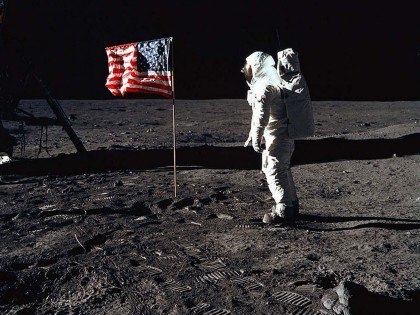
    Have you heard news stories suggesting that the Americans really did not land on the Moon in 1969? Many people believe stories that the images broadcast from the Moon were faked and that the enormous challenge of reaching the Moon prevented a successful mission. Those rumors are all untrue, including recent ones that life forms were seen scuttling away from the astronauts.

    People have been making up “Moon hoaxes” for ages, with the earliest one dating back to Sir John Herschel, who purportedly discovered life on the Moon.

    You can read about it here. http://www.museumofhoaxes.com/hoax/archive/permalink/the_great_Moon_hoax.

    People who continue to wonder about the poor quality of the images broadcast from Apollo 11 by the American astronauts should consider that without the technology we have today, the conversion of the images to a format that would reach our television sets caused a great deal of distortion.

    The Original Moon Walkers

    A total of 12 men have landed during the six successful missions to the Moon. Because of the lack of atmosphere and erosion on the Moon, their footprints will remain visible for at least ten million years! They are:

    • Apollo 11, Neil Armstrong and Buzz Aldrin
    • Apollo 12, Pete Conrad and Alan Bean
    • Apollo 14, Alan Shepard and Edgar Mitchell
    • Apollo 15, David Scott and James Irwin
    • Apollo 16, John W. Young and Charles Duke
    • Apollo 17, Eugene Cernan and Harrison Schmidt
    • You’ll note Apollo 13 is missing from the list. It’s the ill-fated mission depicted in the movie starring Tom Hanks, appropriately called Apollo 13, about a lunar module damaged by an oxygen explosion that barely made it back to Earth.

    Moon walking man

    Yes, It’s True:

    Water was discovered on the Moon in 2009, in lunar ice formations in craters at the poles of the Moon.

    Since the Moon’s orbit takes 27.3 days and February has 28 days, there are some years when there is no full Moon in February.  However, when that happens, you can expect two full Moons in either January or March to make up for it.

    Of Earthlings surveyed back in 1988, 13% of them said they believed the Moon was made of cheese.

    Lunar eclipses always occur during the full Moon, and they cannot last longer than three hours and forty minutes. Since the Moon is obstructed by the Earth’s shadow, and the Earth’s shadow is conical, the duration of the eclipse depends on what part of the cone the Moon is traveling behind.

    Few movies are actually made about the Moon. You can rent 1995’s Apollo 13, or 1964’s First Men In the Moon, based on a story by H.G. Wells. There’s also Capricorn One, a movie made in 1977 about a Moon hoax.  Mars has definitely received more coverage from Hollywood.

    Can You Buy A Piece of the Moon?

    No, you cannot buy Moon rocks. All Moon rocks on Earth are the property of the U.S. government and are not for sale. The only exceptions are Moon rocks given away by President Richard Nixon to various world leaders. The Moon rock given to the head of the Honduran government disappeared and apparently was offered for sale under suspicious circumstances in 1994.

    The best advice from this episode is to avoid anyone trying to sell Moon rocks for cash, especially if they suggest a meeting in the middle of the jungle. They probably won’t sell you a real Moon rock.

    (References:)

    Underhil, Kevin. United States v. One Moon Rock. Forbes.com, at

    http://www.forbes.com/2010/07/08/lawsuit-Moon-rock-legal-humor-opinions-columnists-kevin-underhill.html

    Moonphases.info, at

    http://moonphases.info/

  • About Our Sun

    About Our Sun

    Throughout history people have felt an inexorable draw to the Sun, an irresistible compulsion to set our clocks by its rays, and to honor it as the center of the universe.

    When you realize that the Sun makes up 99 percent of all matter in the solar system, it becomes quite understandable.

    The word Sun actually comes from sunnon in the oldest proto-Germanic languages, dating as far back as 500 BC. Our own word for this bright yellow orb in the sky first appeared in Old English in Beowulf around 725 AD.

    Space shuttle passing in front of sun

    Atlantis Shuttle Passing (Transitioning) the Sun

    The Sun, the World Over

    Have you known a few Sun worshippers in your life, and might you be among them? Legends over centuries past give us stories of Sun worshippers from many eras and from many places all over the globe. Consider how our ancestors from various cultures expressed their respect for the Sun:

    • Ra was the ancient Sun god of the Egyptians. Depicted with the head of a hawk, Ra ruled the sky, the Earth, and the underworld. Ra eventually came to be known as one and the same with Horus, god of the sky, the King, and vengeance. Ra and Horus shared basically the same appearance, although images of Ra depicted a round Sun resting above his head, while Horus wore a red crown. The Egyptians bestowed quite a history on their Sun god: Ra was related to Atum, the god believed responsible for creating the Earth. Horus, on the other hand, was the son of Isis and Osirus, god of the afterlife. Isis served as the goddess of motherhood, fertility, and magic. The Sphinx was built to face east to honor Horus.
    • Maybe you’re more familiar with Apollo, the Greek god of the Sun and sister of Artemis, goddess of the Moon. Most people know Apollo from the mythological adventures told in Homer’s Iliad. However, many people believe that Apollo was just an archer and that Helios was the true god of the Sun. There’s no text that explains the transition from Helios to Apollo.
    • In Japanese culture, Amaterasu came to Earth fathered by Izanagi, the one primal Creator.  This Sun god was actually a woman, a goddess, and she was borne from a single tear shed by Izanagi.
    • The Aztecs had a more warlike sun god, Huitzilopochtli, also spelled Uitzilopochtli, but who’s counting vowels? He was god of the Sun, of war, and of human sacrifice. Legend says when his mother was expecting him, he heard from within the womb of his sister’s plan to kill their mother. When he was born, he came out of the womb in full battle regalia and carrying a knife. Later on, he created the first ball of fire, and his father turned it into the Sun.
    • Hindus worshiped Surya, one of the twelve Adityas that ruled the months of the year. Surya lived in the Sun and he was always depicted with four arms and red skin. Maybe he needed a little more sunblock!
    • Freyr was the Sun god in Nordic mythology. He was madly in love with Gerd, held captive in the underworld. When he bade his servant, Skirnir, to travel to Hades and find her, Skirnir’s journey was marked by the Sun’s travels across the sky.
    • Legends from the northern lands of Great Britain, including Scotland and Ireland, tell us many stories about Sun worshipers. We know very little about the Druids, but it is believed they regarded the Sun as emblematic of their primary deity.

    Sunny Side Up

    Just how hot is the sun? Scientists estimate that the surface temperature measures about 5505 degrees Celsius or 9941 degrees Fahrenheit. Both the core and the corona are much hotter, with scientists estimating a temperature of 27 million degrees Fahrenheit at the core.  The Sun remains the same constant temperature day in and day out, or so it seems—even though the Sun actually gets a little hotter all the time, over the next few billion years it will go up only a few degrees.

    It’s amazing how many people think the Sun is farther away from our planet during the winter months. The truth is that Sun is actually a tad closer during the winter months. However, the Earth’s tilt on its axis away from the Sun during winter months creates a longer angle for the Sun’s light, with the sunshine that reaches us elongated over the Earth’s surface, and so it is a little cooler than what we feel during the summer months.

    Did you think the Sun just sits around all day shining? No, sir. It’s made up of three parts hydrogen to one part helium, and it spends the whole day fusing hydrogen atoms into helium. This means it’s called a “main sequence” star, which generates the energy that keeps it burning. And the Sun is not really yellow, by the way—it’s white. An optical illusion of light called Rayleigh scattering, named after a British scientist, gives us a theory of particle physics that makes the Sun appear to be yellow, at least to our eyes.  It’s the same phenomenon that renders the sky blue.

    The Sun is a big old thing. Scientists say it’s 109 times the size of Earth, at 1,392,000 km (864,948 miles). It’s always about 149,668,992 km (93,000,000 miles) away from Earth. As mentioned previously, it represents 99% of all the matter in the Solar System.  The Sun takes about 225 million years to travel around the Milky Way, and that is what we call a Solar Year. The next closest star is Proxima Centauri, about 26 trillion miles away.

    Storms, Spots, Black Holes, and Novas

    What are solar storms? They have the power to knock out our power grids and interrupt sensitive electronic devices. In a storm that took place in early 2012, Delta Airlines rerouted six airplanes that were supposed to travel over the North Pole.  Generally they are caused when a CME occurs—a coronal mass ejection of intense energy ejected from the Sun’s surface.

    Sunspots mostly occur around or below the Sun’s equator. They result from interaction of the Sun’s gases with its magnetic fields. Scientists have noted that the Sun cycles through increasing and then decreasing magnetic activity every eleven years—a unit of measurement that they call the solar cycle—but even they are not certain when one cycle ends and another begins.

    Solar flares occur when energy creates outward explosions on the Sun’s surface, but they remain invisible to us because they are eclipsed by the Sun’s natural radiance.

    Black holes occur when a star dies. After its nova, it collapses into itself. With an intense gravitational force, it remains compacted so densely that light cannot escape from it. Only massive stars can become black holes—a size about three times that of the Sun. So if you’re worried about the Sun becoming a black hole, you can set your mind at rest!

    Many people do continue to worry about the Sun burning out, however. So just how long is it expected to last? According to Dr. Eric Christian of NASA, Scientists believe it’s got a lifespan of about 10 billion years. So far they think it’s 4.7 billion years old. So we have a long time to go until our Sun’s nova. Get out your sunglasses, hop into a hammock, and relax!

    You’ll also discover some interesting Solar System Facts here

    Read More About It

    Cosmicopia, by NASA. Ask Us – The Sun, at

    http://helios.gsfc.nasa.gov/qa_sun.html#sunlife

    Solar System Exploration, The Sun. NASA website at

    http://solarsystem.nasa.gov/planets/profile.cfm?Object=Sun